
The Controller Shortage in Numbers
By Jesse Vazquez, Founder & Managing Partner · October 26, 2026
Quick answer: Controller pay is rising because demand is outrunning the pipeline. Robert Half's 2027 Salary Guide puts the national midpoint for a corporate controller at $187,500 (and $213,750 in Dallas), while 61% of finance leaders told the Controllers Council this summer that they're short on accounting and finance talent. Meanwhile, U.S. schools awarded about 55,000 accounting degrees in 2023–24, roughly half the number of accountant and auditor openings BLS expects each year.
How short is the supply of controllers right now?
The Controllers Council describes 2026 as the year finance hiring rebounded to pandemic-era levels after a two-year lull, and the shortage numbers moved with it. In its July 2026 analysis of the Corporate Finance & Accounting Talent Study, the Controllers Council reported that 61% of finance leaders now see shortages of accounting and finance talent (CPAs included), with 15% calling the shortage significant. The same study had shown a talent surplus one year earlier.
For controllers and the accountants working toward that seat, this is a good position to be in. Companies short on finance talent compete hardest for the people who can run the close, and that shows up in offers.
What does a controller earn heading into 2027?
Robert Half's 2027 Salary Guide lists a national range for corporate controllers of $154,500 to $216,250, with a midpoint of $187,500. The Dallas range runs higher, with a midpoint of $213,750 and a top of $246,525.
Federal data tells a similar story. BLS groups controllers with treasurers and finance directors under financial managers, whose median pay was $166,570 in May 2025. Industry matters at the margin: the median was $174,170 in professional, scientific, and technical services and $164,400 in manufacturing.
In our searches, the controllers who land at the top of those ranges usually bring something specific. Construction job costing and WIP, private equity reporting, multi-entity consolidation, or a recent ERP migration can all move the number, as we wrote in Construction Accounting Pays a Premium.
Why isn't the pipeline keeping up?
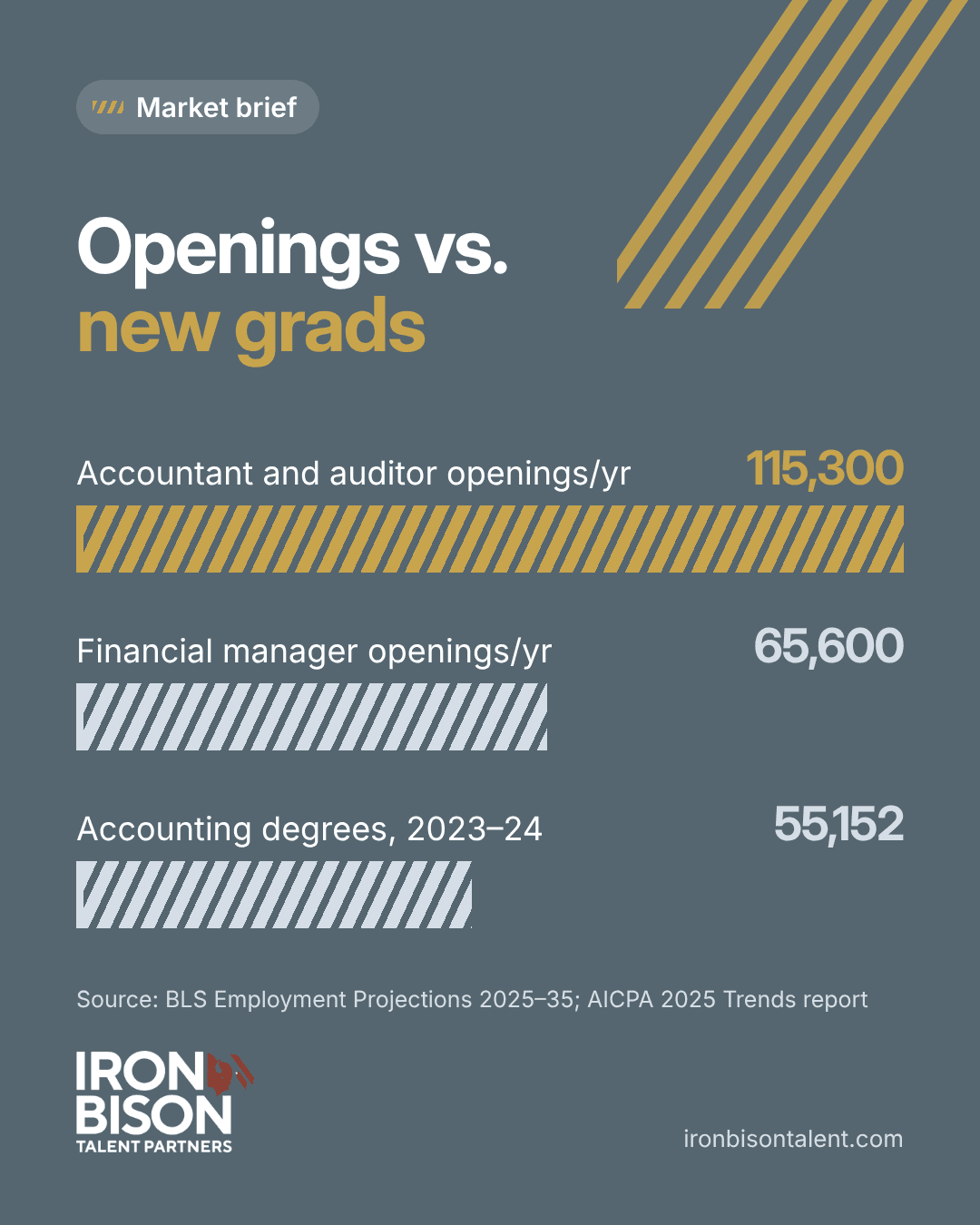
Start with how many people enter the profession. The AICPA's Trends report, summarized in the Journal of Accountancy, found that schools awarded 55,152 accounting bachelor's and master's degrees in 2023–24, down 6.6% from the year before. Master's degrees in accounting and taxation fell about 15%.
Now compare that with demand. BLS projects about 115,300 openings a year for accountants and auditors through 2035, and about 65,600 a year for financial managers, an occupation BLS expects to grow 10% over the decade. Most of those openings come from people retiring or changing careers, so they won't all be filled by new graduates, but the gap still explains why experienced candidates have so much bargaining power right now.
The controller seat sits at the end of that pipeline. Robert Half notes that the role typically requires about 10 years in finance and accounting, five of them managing people. The thin graduating classes of the past few years are the senior accountants and accounting managers who should be ready for controller jobs around the end of this decade.
Is the pipeline getting any better?
There are early signs of improvement. The same AICPA data shows enrollment in U.S. accounting programs reached 266,506 in spring 2025, up 12.4% from the prior year and the highest since 2020. The CPA side is murkier: new exam candidates dropped to 28,082 in 2024 from 42,626 in 2023, which the Journal of Accountancy tied to major exam changes that year.
Higher enrollment will help the staff accountant market in two or three years, but it won't produce controllers for a long time. For anyone already on the path, that should keep the market in your favor for the next several years.
What should controllers do with this?
If you're a controller or an accounting manager close to the seat, this is a good market to know your number. The Controllers Council also found that finance and accounting compensation increases nearly doubled from the year before. Get a current read on your market value before your year-end review, especially if your company is adding entities or getting ready for a sale.
If you're an accounting manager or assistant controller, the shortage works in your favor too. Companies that can't find an experienced controller are more willing to promote someone a step early, especially at smaller and mid-sized companies. Our guide on how to become a controller walks through that path seat by seat.
Frequently asked questions
How much does a controller make in 2026?
Robert Half's 2027 Salary Guide puts the national midpoint for a corporate controller at $187,500, with a range of $154,500 to $216,250. BLS reports a May 2025 median of $166,570 for financial managers, the federal category that includes controllers.
Is there a shortage of accountants in 2026?
Yes. The Controllers Council reported in July 2026 that 61% of finance leaders face shortages of accounting and finance talent, while accounting degrees awarded fell 6.6% in 2023–24.
How many years of experience do you need to be a controller?
Robert Half says the role typically requires about 10 years of finance and accounting experience, including five in a managerial role. Many companies also prefer a CPA or an MBA.
Will the controller shortage ease soon?
In our view, probably not before 2028. Accounting enrollment rose 12.4% in spring 2025, but those students are years away from controller-level experience.
Iron Bison works with controllers and CFOs across the country, with a deep bench in construction and real estate. Learn more about how we work with finance candidates, or start a confidential conversation about your next move.


